The golden years of cloud AI won't last
AI compute is priced well below what it costs to build right now. How I use rented GPUs, cheap open-model APIs, NVIDIA's free tier and a $20 Claude plan while the pricing lasts, with the numbers behind it.

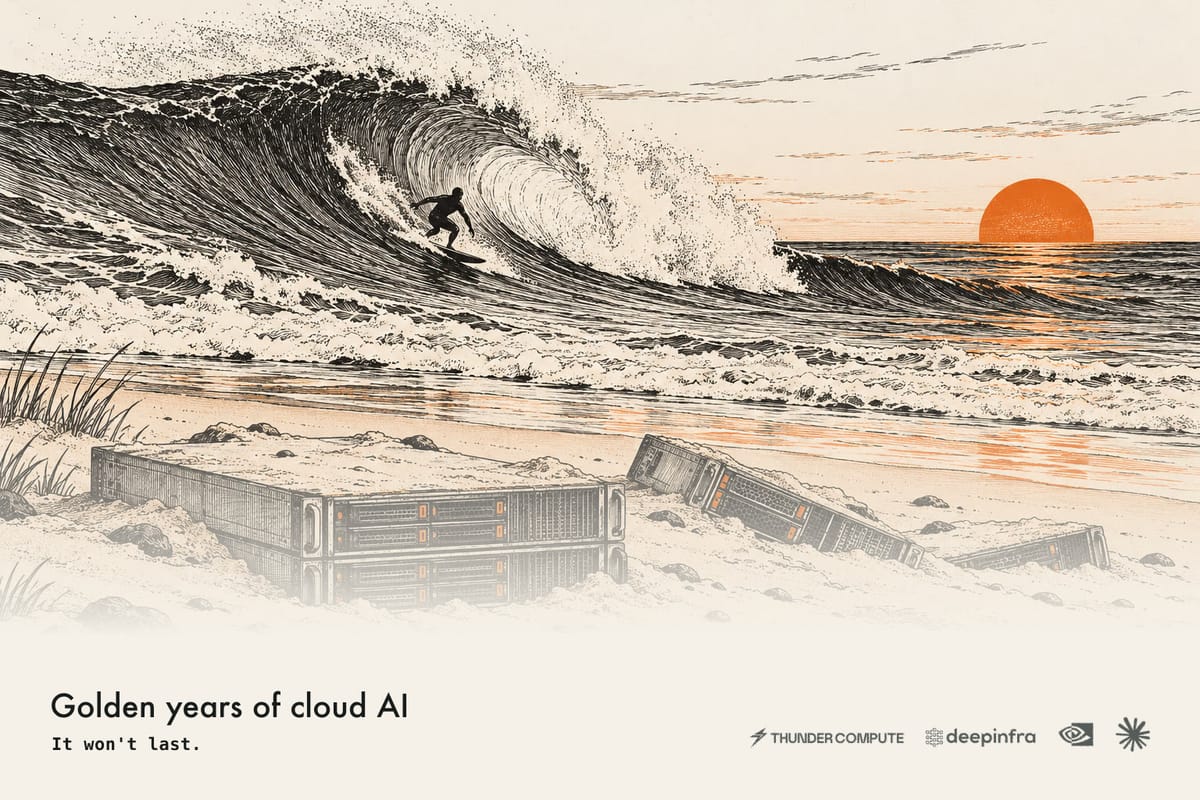
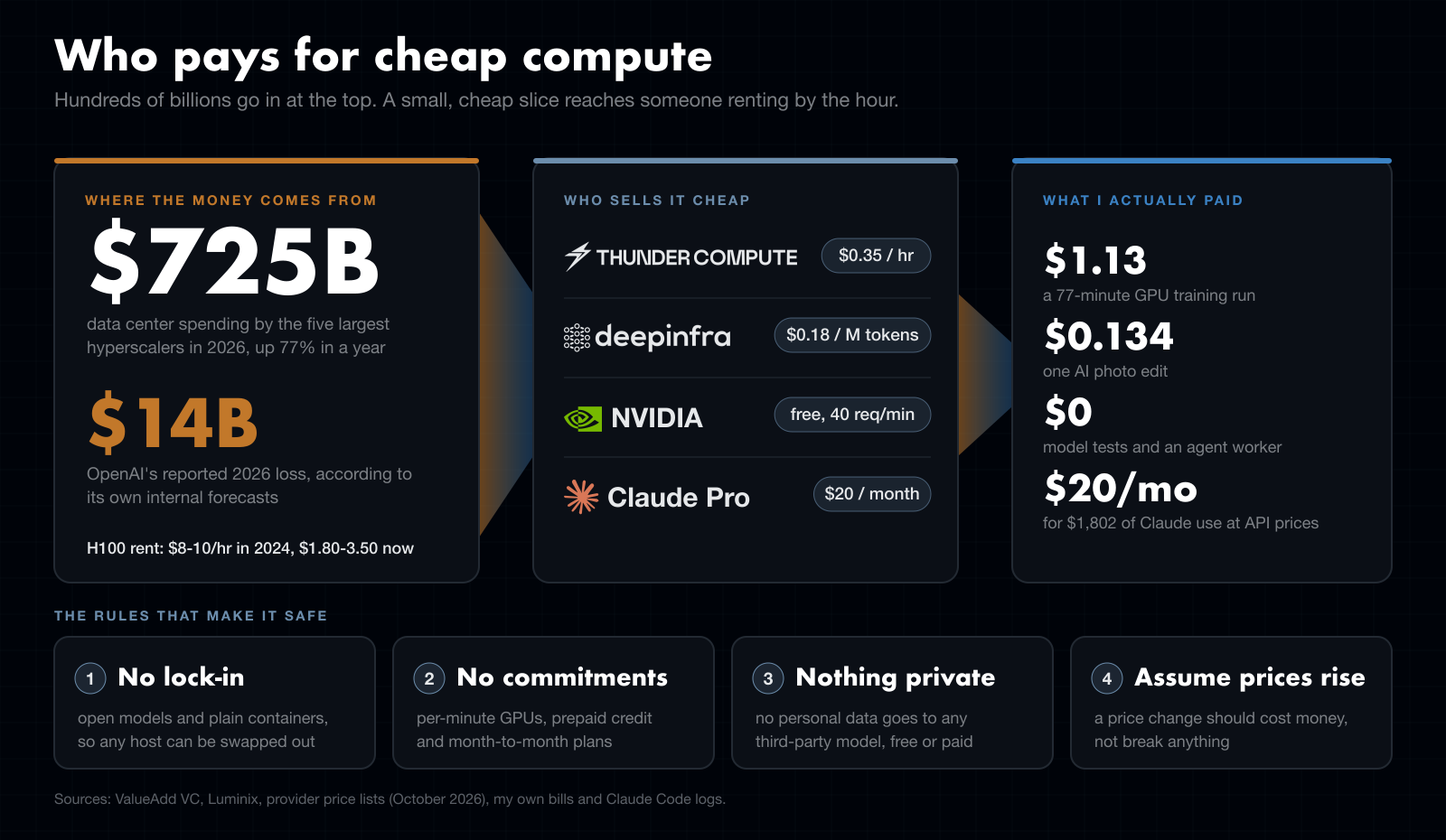
AI is on sale right now, and the sale can't last. Compute is priced below what it costs to provide: the largest tech companies are spending hundreds of billions of dollars a year on data centers, GPU rental prices have fallen by two thirds since 2024, open models are sold per token for a fraction of frontier prices, and subscription plans include far more usage than they charge for. This is a bubble. My plan is to enjoy it while it lasts: rent GPUs by the minute instead of buying them, buy tokens from the cheapest host that serves an open model well, use free tiers where they exist, and avoid anything that would leave me stranded when the bill finally comes due.
King Canute and Bruce Lee
In the popular version of the story, King Canute set his throne on the beach and ordered the tide to turn back, and the sea, unimpressed, soaked him anyway. Bruce Lee described the opposite approach in a 1971 episode of the TV series Longstreet: "Be water, my friend." Water doesn't fight what it runs into. It takes the shape of whatever holds it and keeps moving.
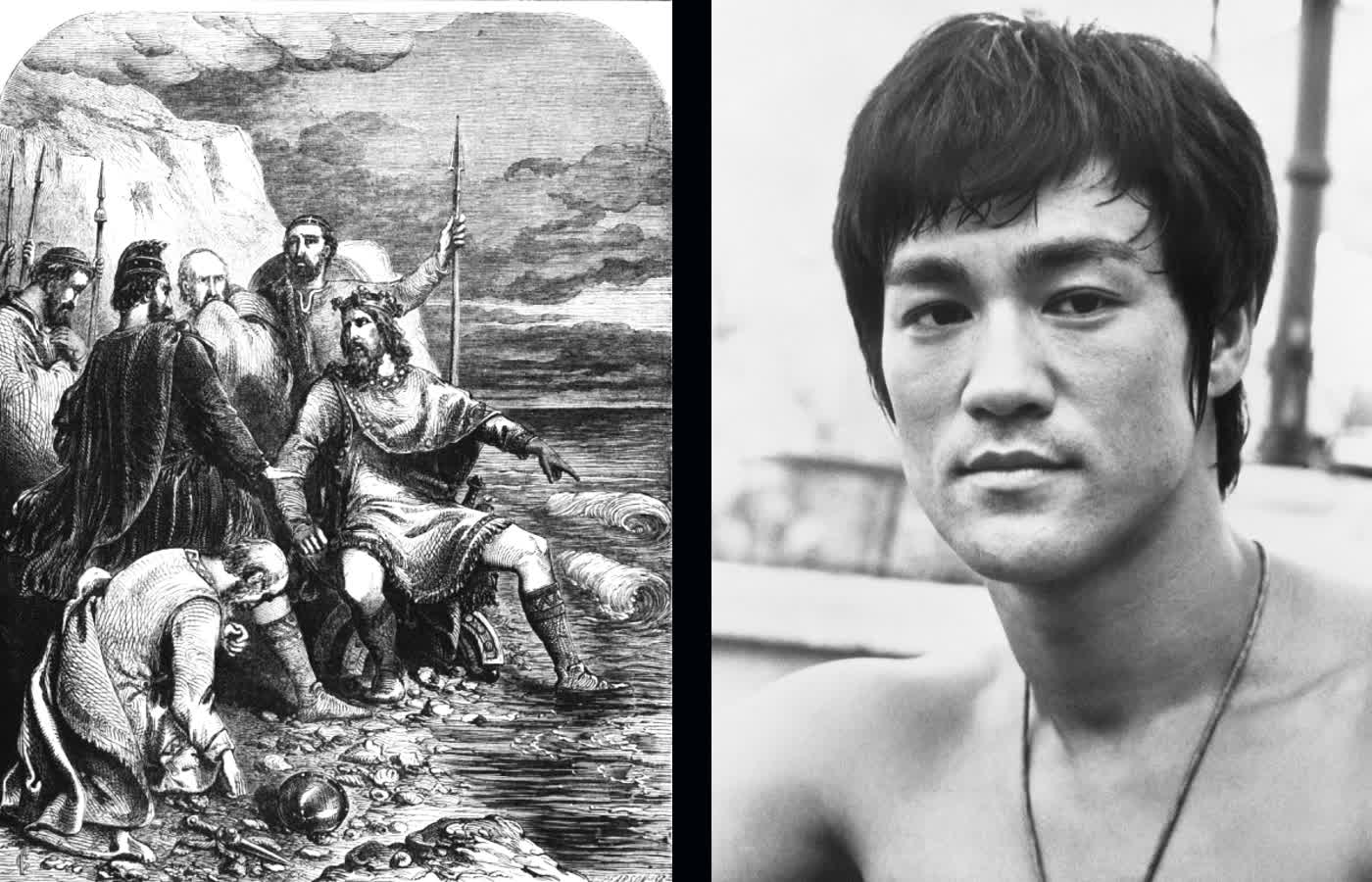
Left: Canute reproving the flattery of his courtiers, from Cassell's Illustrated History of England. Right: Bruce Lee in a 1971 National General Pictures publicity photo. Both public domain, via Wikimedia Commons (Canute, Lee).
I think the two together are the best way through the current AI market. Nobody can order the spending to stop or the low prices to stay, so I don't try. I take the shape of it while it's here: rent instead of buy, pay per token, use the free tiers, and keep everything portable so I can move when the water does.
The bubble in numbers
The spending figures have gotten so large they're hard to picture, so here they are next to the revenue and losses.
- Spending. The five largest US hyperscalers are on track to spend about $725 billion on capital expenditure in 2026, up 77% from about $410 billion in 2025, with $1 trillion projected for 2027 (ValueAdd VC). BloombergNEF puts the 14 largest public data center operators at close to $750 billion this year (BNEF).
- Revenue. Sequoia's "$600B question" framed the gap in 2024: the revenue AI companies would need to justify the hardware being bought was far larger than the revenue they had, and the spending has grown much faster since. Nobody has answered the question. The industry just made it bigger.
- Losses. OpenAI is reported to be losing about $14 billion in 2026, with inference costs alone projected at $14.1 billion (Luminix fact sheet). Several analysts estimate API prices would need to rise 3 to 10 times to reach sustainable margins (Nadir). These figures come from reporting on leaked forecasts and should be read as approximate.
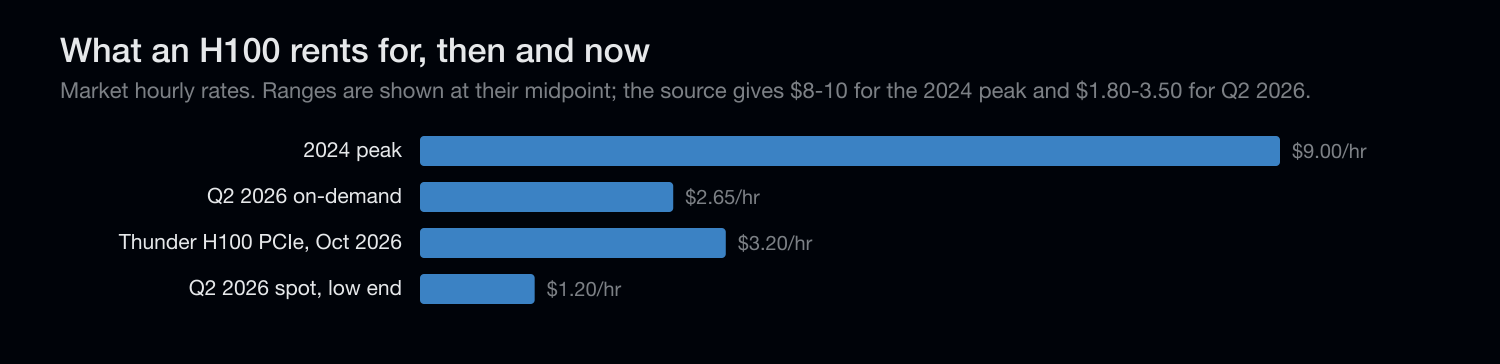
- GPU rental prices. H100 rental rates have fallen 64 to 75% from a 2024 peak of $8 to $10 an hour to $1.80 to $3.50 in mid-2026, with spot capacity as low as $1.20 (ValueAdd VC).
Thunder Compute
Thunder Compute rents GPUs by the minute with no commitment. I rent from it whenever a job needs an NVIDIA GPU. For example, the wake word training run in my first post used an L40 for 77 minutes and was billed $1.13. A trained model for about the price of a coffee.
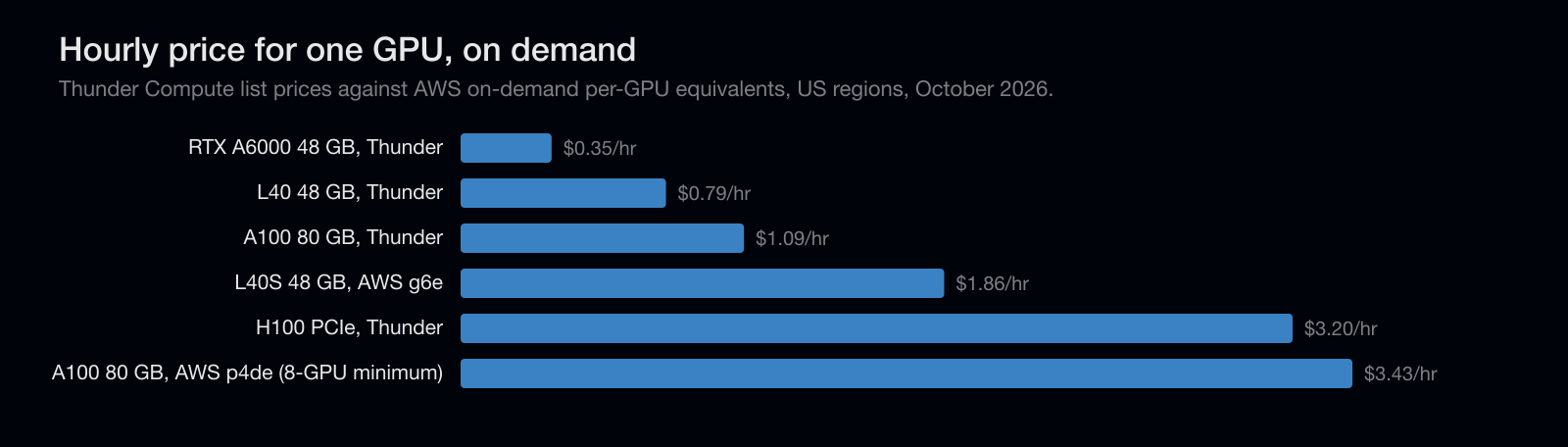
| GPU | Thunder Compute | AWS on-demand, per GPU |
|---|---|---|
| RTX A6000, 48 GB | $0.35/hr | not offered |
| L40 / L40S, 48 GB | $0.79/hr (L40) | $1.86/hr (L40S, g6e.xlarge) |
| A100, 80 GB | $1.09/hr | $3.43/hr (p4de, 8 GPUs minimum) |
| H100 PCIe | $3.20/hr |
AWS prices are from Thunder's comparison and the L40S tracker. The L40 and L40S are close relatives, not identical cards.
Buying instead of renting doesn't make sense at my usage. A used RTX A6000 sells for about $4,260 (GPUDojo). At $0.35 an hour, that pays for 12,171 hours of rental, about 16 months running around the clock, before counting power or the computer it goes in.

The catch is availability. The cheapest card is popular for obvious reasons, and the A6000 was sold out the last time I went to rent one, so I paid more than twice the rate for an L40 instead.
DeepInfra
DeepInfra hosts open-weight models and charges per token. It's what I use for one side task in my home AI agent and for photo edits, where an image edit with Google's Gemini 3 Pro Image model costs $0.134.
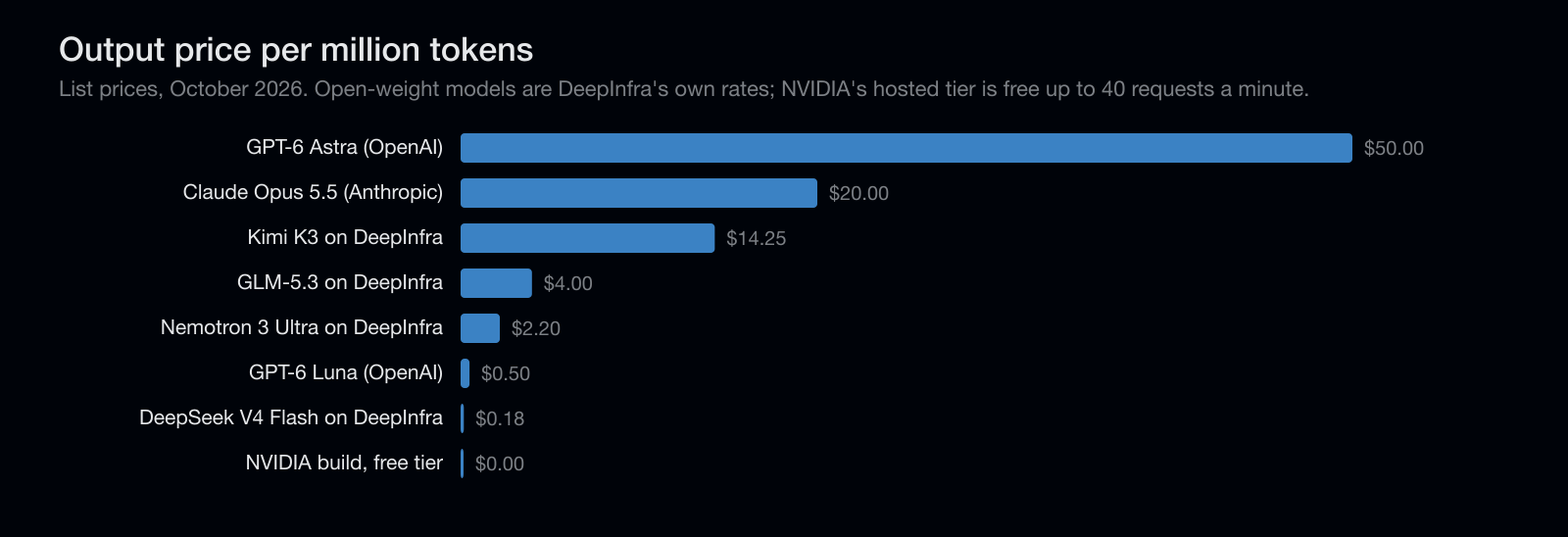
| Model | Input, per million tokens | Output, per million tokens |
|---|---|---|
| DeepSeek V4 Flash on DeepInfra | $0.09 | $0.18 |
| Nemotron 3 Ultra on DeepInfra | $0.50 | $2.20 |
| GLM-5.3 on DeepInfra | $0.90 | $4.00 |
| Kimi K3 on DeepInfra | $2.85 | $14.25 |
| Claude Opus 5.5 (Anthropic) | $4.00 | $20.00 |
| GPT-6 Astra (OpenAI) | $10.00 | $50.00 |
DeepInfra prices are from its public model list on October 3, 2026. OpenAI's rates are from CloudZero. The open models aren't equal to the frontier models on every task, but for summarizing, classifying and routine agent steps, the cheapest ones are good enough at a hundredth of the price, which is hard to argue with.
NVIDIA's free API
NVIDIA's build.nvidia.com hosts more than 80 models behind an OpenAI-compatible API, free for developers. Not cheap, free. The limit is about 40 requests per minute per model (NVIDIA developer forum). I used it to evaluate a batch of models side by side, and one of them, GLM-5.3, now runs the video prep job in my home agent.
Free comes with strings. It returns 503 errors and timeouts under load, the rate limit varies with traffic, and the model list changes without notice. I use it for work that can wait and retry, and I keep a script that checks every morning that the models I depend on still answer.
A $20 Claude plan
The best deal in AI right now might be the one in my own account. I've been on Claude's Pro plan, $20 a month, the whole time. Claude Code keeps a log of every request on my Mac, including token counts, so I totaled them by week and priced them at the API rates for Claude Opus 5.5: $4 per million input tokens, $20 per million output tokens, $0.20 per million cached tokens read and $5 to $8 per million written.
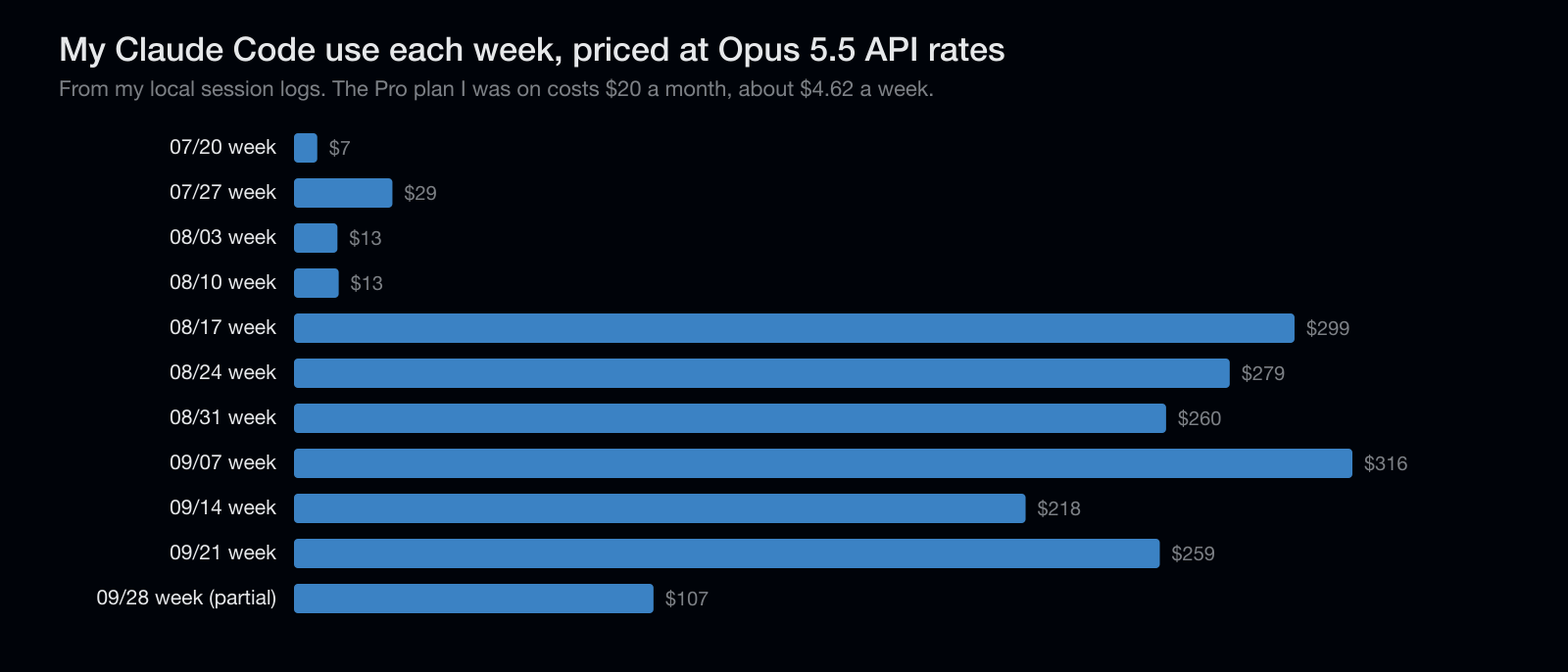
| Weeks logged | 11, from July 20 to October 3 |
| Output tokens | 13.8 million |
| Cached input read | 4.7 billion tokens |
| API value of the whole period | $1,801.79 |
| Typical week since mid-August | $218 to $316 |
| What Pro costs per week | about $4.62 |
That's roughly 50 to 70 times what I paid in a heavy week, and that's an amazing deal for $20 a month. It's also completely unsustainable. Almost all of the volume is cached context being re-read on every turn of a long coding session, which costs Anthropic real compute and is included in the flat rate.
A few caveats, because a number like that deserves them:
- SemiAnalysis bought every Claude and ChatGPT plan in June and used each one up to its weekly limit. As reported by Cybernews, it put a fully used $20 Claude Pro plan at about $400 a month of tokens at API prices, the $200 Claude Max plan at about $8,000 and the $200 ChatGPT Pro plan at about $14,000, and said the labs are more likely to hold new models back from subscriptions than to cut limits. SemiAnalysis's own report is paywalled, and I haven't verified these figures against it yet. My logged figure for Pro is higher than its estimate, and I haven't worked out why; the way cached tokens are counted is the likely difference.
- I priced everything at Opus 5.5 rates. Most of my requests actually went to Opus 5, which costs more per token, so the real API value is higher.
- The logs only cover this Mac.
- Independent measurements agree on the scale. One developer measured a full week of the $100 Max plan at about $523 of API usage at Opus 4.6 prices (Botfarm).
The rules I follow
- No lock-in. I use open-weight models and plain containers wherever possible, so moving to another host is a config change.
- No commitments. GPUs by the minute, tokens on prepaid credit, subscriptions month to month.
- Nothing private goes to a third-party model, paid or free. The free tiers in particular may log what they receive.
- Assume every price here goes up. If Thunder doubles its prices or a free tier disappears, the work should still run, just at a higher cost.
Risks
- Prices can rise quickly when investors stop subsidizing growth. The 3 to 10x estimates above would change the math for anyone building a business on today's API prices.
- Small providers can disappear. Thunder Compute and DeepInfra are both younger companies than the hyperscalers they undercut.
- Free tiers end without warning, and subscription limits get tighter.
Verdicts
- Thunder Compute: the cheapest GPUs I've found and the simplest to use. Availability on the cheapest card is the weak point.
- DeepInfra: a large catalog of open models at very low prices, with a public price list. I'd keep a second host configured in case it goes away.
- NVIDIA build: genuinely free and useful for testing, not reliable enough to depend on.
- Claude Pro: worth far more than it costs right now. I don't expect that to last, so I'm using it while it does.
Next
A local copy of the models I depend on, so that the work that matters most doesn't depend on anyone's pricing.
Credits
- Logos belong to Thunder Compute, DeepInfra, NVIDIA and Anthropic. The NVIDIA and Claude marks are from Simple Icons.
Sources
- Wikipedia: King Cnut and the tide
- Wikipedia: Longstreet (TV series), the 1971 episode "The Way of the Intercepting Fist"
- ValueAdd VC: Big Tech AI capex hits $725B in 2026
- ValueAdd VC: is the AI chip shortage over in 2026
- BloombergNEF: AI data center build advances at full speed
- Sequoia: AI's $600B question
- Luminix: OpenAI financial fact sheet
- Nadir: OpenAI's loss and subsidized API prices
- Thunder Compute pricing and A100 price comparison
- GetDeploying: L40S cloud pricing
- GPUDojo: RTX A6000 used prices
- DeepInfra pricing
- CloudZero: OpenAI API pricing
- NVIDIA developer forum: NIM API rate limits
- Botfarm: the true price of a Claude Max weekly limit
- Cybernews: how much your ChatGPT and Claude usage costs OpenAI and Anthropic, reporting SemiAnalysis's June 2026 analysis (not yet verified against the primary report)